Friday, 12 October 2012

Casting and Character Development

JAKE BROWNBILL - Unknown Male

Jake is an extremely artistic character; I chose to have him portray the male in my feature with plenty of acting experience.  He will be able to add mystery to the film, and adapt to the surrealist nature of the piece.  He featured in another student's film opening sequence for AS in the previous year, and currently contributed to a friend's narration to her piece; with some theatrical experience such as local productions such as 'Basset'.  
 
ELA GÖK - Unknown Female
 
Half turkish, half English, my best friend Ela is an artistic individual studying A2 Fine Art and is very suitable for being a cast extra who appears in my Unknown Male's dream.  A love for vintage style in terms of items and clothing; her mannerisms are almost identical to those of sophistated women in the early 20th century era.

I have not developed my main character, Unknown Male as his obsession with the element of time overpowers and is the main characteristic of his persona.  Unknown Female is also a shadow shown in his memory.  We do not know who she is.

The characters are seen to communicate through the use of body language and facial expressions which create the narrative of the short feature; the use of props highlight the intentions of the characters.  Due to the film being silent; a lot of depth and emotion allow the audience to engage with the story and question the actions in the scenes.

Thursday, 11 October 2012

Salvador Dali

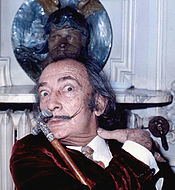
Salvador Dali is my main inspiration for my feature; a surrealist painter and film-maker born in Figueres, Spain in 1904. He was well known for the portrayal of bizarre surreal images in his works, his painterly skills were often attributed to the influence of Renaissance masters. Dali explored many artistic methods such as film, sculpture, and photography, in collaboration with a range of artists in a variety of media. 'The Persistence of Memory' was completed in 1931, and was his best known work. His eccentric manner and attention-grabbing public actions sometimes drew more attention than his artwork, he was highly imaginative.
 
The Dali Atomicus, photo by Philippe Halsman (1948)
ARTWORKS
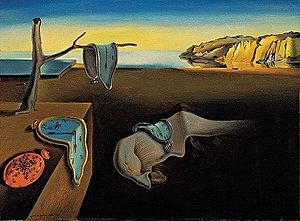
THE PERSISTENCE OF MEMORY (1931)
The painting by Dali stresses his theories of 'softness' and 'hardness'; the soft watches connote to "the unconscious symbol of the relativity of space and time, which is a Surrealist meditation on the collapse of our notions of a fixed cosmic order" - as described by Dawn Ades. This painting is believed to support Einstein's Special theory of Relativity - but Dali would deny this to perhaps confuse viewers and suggest that the softness is likened to melting Camembert cheese.  A human like figure is clear in the centre, which suggests Dali himself, the use of ants such as on the orange clock represent either death, or in other painting female genitalia.  The figure in the middle of the picture can be read as a "fading" creature, one that often appears in dreams where the dreamer cannot pinpoint the creature's exact form and composition.  The iconography may refer to a dream that Dalí himself had experienced, and the clocks may symbolise the passing of time as one experiences it in sleep or the persistence of time in the eyes of the dreamer.  Dream like imagery is more likely to be portrayed rather than full-waking consciousness.     

DREAM CAUSED BY THE FLIGHT OF A BEE AROUND A POMEGRANATE A SECOND BEFORE AWAKENING (1944)
 
Refferred to a 'hand-painted dream photograph', this surrealist piece by Dali suggests his wife Gala, his wife as the main subject of the scene.  The bayonet is a suggestion to a stinging bee, the tigers distinct stiped pattern also suggest the bee body shape.  This is a reference to Freud's dream theories, where the womens abrupt awakening from her peaceful dream is represented.  The fish may represent the bee's eyes, because of similarity of the fish's scaly skin with the scaly complex eyes of bees.  The elephant is a distorted version of the "Pulcino della Minerva" sculpture by Gian Lorenzo Bernini facing the church of Santa Maria sopra Minerva in Rome.  There is a heart-shaped shadow cast by another, smaller pomegranate which represents Venus.  It has also been a suggestion that this is representation of the Theory of Evolution.  Dalí said his painting was intended "to express for the first time in images Freud's discovery of the typical dream with a lengthy narrative, the consequence of the instantaneousness of a chance event which causes the sleeper to wake up. Thus, as a bar might fall on the neck of a sleeping person, causing them to wake up and for a long dream to end with the guillotine blade falling on them, the noise of the bee here provokes the sensation of the sting which will awaken Gala."
 
THE FACE OF WAR (1941)
 
The trauma of war often served as an inspiration to Dali's artworks; he painting towards the end of the Spanish Civil War and World War 2.  A disembodied face hovers aganst a deser landscape, almost like a corpse which suggests misery.   In its mouth and eye sockets are identical faces. In their mouths and eyes are more identical faces in a process implied to be infinite.  This is an emphasis on the results of war; a symbol of endless death and decay.

LOBSTER TELEPHONE (1936)

Dali believed that objects were a reflection of subconscious motives, that also revealed secret desires.  The lobster usually appears in drawings by Dali that suggest sexual connotations and erotic pleasure - this piece is playful and witty.


THE PERSISTENCE OF MEMORY - SCULPTURE (1980)

Dali examines human perception of time again through the same painting, through sculture form that suggests a limp clock on a tree branch, a symbol of life.   In his words, "Materialization of the flexibility of time and the indivisibility of time and space. Time is not rigid. It is one with space - fluid".  The limp watch no longer 'keeps' time; it does not measure its passage. 

Wednesday, 10 October 2012

Film Pitch Responses


Stop-motion Animation

Stop-motion of moving penny
Stop-motion is an animation technique which allows the manipulation of inanimate or animate objects to move - with minuscule movements in between individually photographed frames, that therefore create the illusion of movement after the sequence is played continuously.  There are a range of computer software's that can be used to create this stop-motion effect; there are different types of stop-motion animation:
 
PUPPET ANIMATION
 
'Coraline'

Puppet figures interact with each other in a constructed environment,  created with armature inside them to keep the structure firm and steady, during the movements and photographing stages.  These are used in many films such as a favourite of mine, 'Coraline' (2009) and Tim Burton's 'Corpse Bride' (2005) and 'The Nightmare Before Christmas' (1993).
 
PUPPETOON
 
This technique created by George Pal is similar to regular puppet animation; but rather than using the same puppet to create different poses for each frame there are a variety of different versions of the same puppet to be used for the animation.  Therefore a near duplicate version of each puppet is used for the next frame, replacing the previous one. 
 
George Pal's Jasper Puppetoons Films
CLAY/ PLASTECINE ANIMATION
 
'Wallace and Gromit'
 Malleable figures/ dolls are created using clay or a similar material to create the stop-motion frames, with an armiture or wiring inside to create the skeleton - keeping them steady and easy to manipulate to pose the figures.  The figures may be made entirely out of clay and morph into a variety of shapes and sizes inbetween different frames - such as the famous 'Dimensions of Dialogue' by Jan Svankmajer and 'Wallace and Gromit' shorts and 'Chicken Run'.
 
CUT-OUT ANIMATION
 
'South Park'


This stop-motion technique uses two dimensional cut-out shapes using materials such as paper or cloth; using either scanned images on a conputer or vector graphics that physically cut the shapes - this type of stop-motion is known to be one of the earliest methods.  Feature animations such as 'South Park' were known to first use this method in the earlier epidsodes before switching to actual computer animation. 


OBJECT ANIMATION
 
Object animation is the use of inanimate objects opposing the idea of specially crafted objects for a specific use.  These are just moved along in stop-motion like in Jan Svankmajer's films such as 'Alice' and many others.
 
GRAPHIC ANIMATION
 
Jan Svankmajer: 'Historia Naturae'
Flat, visual and graphic material such as photographs, newspapers etc. are used and manipulated frame by frame to create a moving image using stopmotion.  The graphics may stay stationary, whilst the camera is moved along to again create the effect.    
 
BRICKFILM
 
Again, another stop-motion technique uses objects such as LEGO or other similar brick-like toys to create animation - the bricks are pieced or moved and again photo's are taken in order to be pieced
together later.  This type of animation uses a micture of stop-motion and live action. 
PIXALATION
 
Pixalation is the use of live humans as stop-motion characters which creates a variety of surreal effects such as sudden and instant disappearances/ appearances - which can allow interesting atcivity to take place such as levitation or sliding around in various positions.


Monday, 8 October 2012

Jan Švankmajer

Stop-motion film maker, Jan Švankmajer is a Czech artist who is well known for his 'surrealist' animations and features.  A puppet theatre was given to him at Christmas when he was a child; an early influence to his artistic development, later studying at the College of Applied Arts in Prague, then the Prague Academy of Performing Arts.  He later joined the Czechoslovakian Surrealist group and was soon gaining a reputation for his distinctive use of stop-motion to create animations/ pictures, also using clay animation and breathing life into inanimate objects.
'Dimensions of Dialogue'

He is known to create short films, his trademarks in his films include exaggerated use of foley sounds - such as in eating scenes and fast motion sequences - such as when characters are walking or interacting.  Food is usually a favourite subject and medium in his films - such as in 'Food' or 'Meat Love', which are very experimental and artistic.  Many of his films are depicted from the idea of a child's perspective - yet have a night-marish and thrilling outcome which is almost disturbing; yet have a comical outcome.  I think this is effective - especially in a short film as they can entice the audience.


'Meat Love' is a very comical one minute long sequence that shows two pieces of meat, romantically involved.  They spin and dance to the music and play in the flour - and are then brutally plunged into a pan to be fried.


'Food' is one of my favourite films - the sequence is amusing and comical; split into the three meals of the day.  Starting off with Breakfast, a man is seen entering a room where he reads instructions, using the robotic waiter style man to dispense the food - it is some sort of spell as once he eats, he is frozen, freeing the previous waiter.  Lunch shows two men failing to catch the waiters eye at a restaurant - and therefore end up eating everything inside, including the table, chairs, clothes, cutlery most probably themselves.  The final meal of the day, shows dinner being presented and garnished on a plate with a variety of sauces and dressings, we soon realise that these are all organs - after a waiter nails a fork to his wooden hand prior to devouring his real hand.

'Alice'
I find that Jan's use of stop motion is very artistic - especially in depicting surrealist themes as the images form are almost ever so slightly disjointed to create a moving product, which I would love to re-create - however due to timing and lack of experience I feel I will not be able to.  In terms of mise-en-scene, he uses inanimate objects and brings them to life, creating scenarios that we may not understand - I find it however comical and amusing - also slightly disturbing for an audience.

Thursday, 4 October 2012

Big Brother Audition

We were given a scenario - to imagine who the worst character would be to endure in a lift that is out of order for two hours, to help my understanding of character development and portrayal.  From a personal point of view; I dread a character who is obsessed with make-up and their appearance in a 'plastic' way,  a person who is under-educated and does not take in account people's feelings or opinions.  I used Martha to portray my dreaded dumb and naive character in the style of a Big brother audition tape, which allows her to improvise using her amusing acting skills to create the character introducing themselves in order to be chosen.

Monday, 1 October 2012

Get off my Land!

Casting to find suitable characters was pleasant - using our Producer/ Location director Aimee Shingfield's father for the farmer role; luckily that is his actual job! He was therefore very suitable, being a similar age to the actor in the original clip (of course younger) - he also has a gun!  The young male and female character were portrayed by Abi Jacobs and James Softly; fellow students and also our friends at Wymondham High Sixth Form.  Abi had previously studied Drama at GCSE and was therefore able to act excellently.  Her physical appearance also supported that of the female character in the film, with reddish/ brunette, wavy hair - which is why we chose her to feature in our remake.  James has not had any acting experience per say - yet he was very successful; with a similar build and hair.

Shot of James and Abi
Our camera operator was very skilled in recreating the shots as we all attempted to create the film shot for shot - using the same camera angles and types of shots.  After organizing props and the location - Aimee's farm we were able to shoot successfully - Ben's camera being fitted with a decent recording microphone therefore we did not have to re record our dialogue.  It was a pleasant experience - especially creating a ketchup and BBQ sauce concoction to flick on our actresses face for the splattered blood effect.


Evaluation 


  • The media product captures real conventions in the sense that it replicates a short film, with a quirky and unique plot.  We used professional planning methods such as creating a script and drafting a storyboard in order to create the film like the original; organising props and costumes and effective casting.  This way the recreation is well thought and organised, this is always clearly seen in the end product.  
  • Audience feedback suggested that it was humorous and replicated well; framing the shots exactly like the original media product and using the same angles, timing and editing to create the narrative.
  • I think that as a group we all cooperated and were able to work successfully; each group member being given a particular role we could finish the job and do as best as we were able to.  If we were to improve the recreation - we would have made sure that the storyboard/ outline wasn't simplified to match the real product as much as possible.